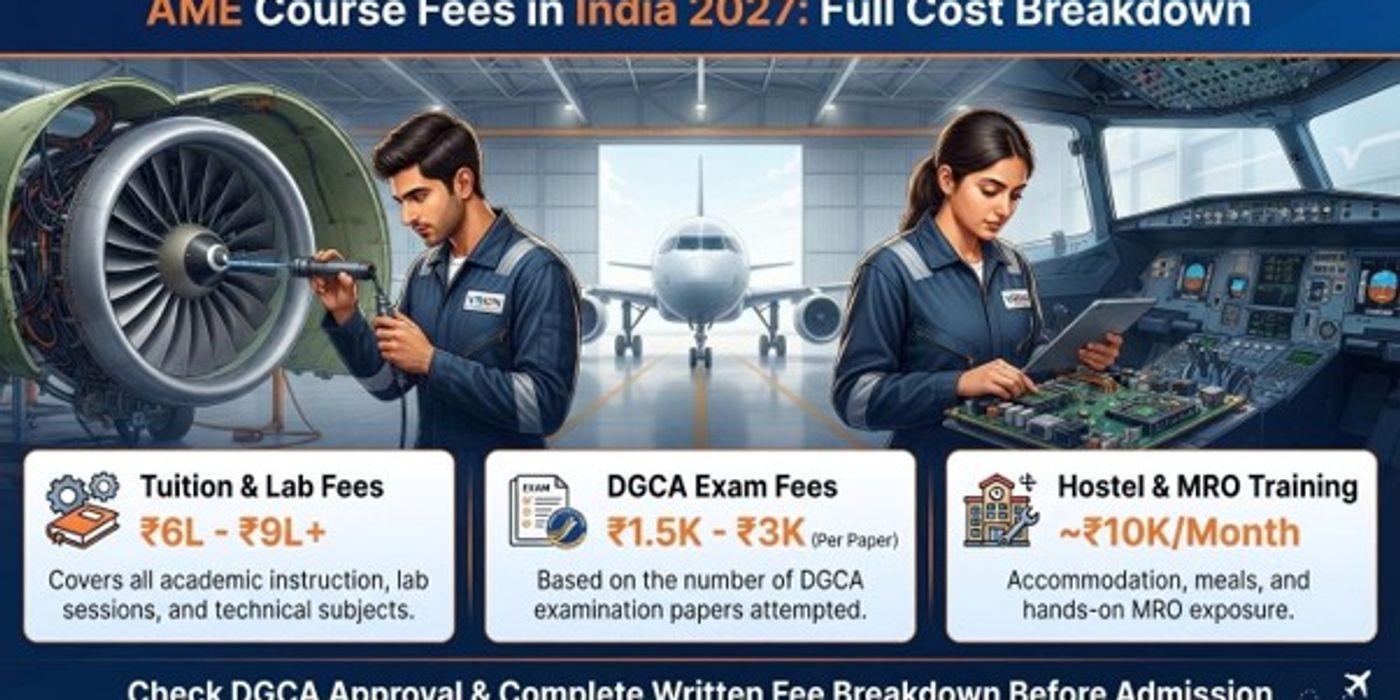
AME Course Fees in India 2027: Full Cost Breakdown
Explore AME course fees in India 2027, including tuition, admission, DGCA exams, practical training, hostel expenses and complete cost breakdown
AME Course Fees in India 2027: Full Cost Breakdown
An Aircraft Maintenance Engineering (AME) course is an aeronautical course that focuses on the inspection, maintenance, troubleshooting and repair of aircraft. One of the ways a student and his/her parents can know which institutes are good or not before choosing them, is to find the cost of the Institute of AME course in India.
The fees of AME Courses in India 2027 will vary depending on the institute, category of the course, training facilities, and the experience that could be gained from practical training as well as an extra degree. In addition, the cost of the hostel accommodation, cost of DGCA exams, uniform, books and cost of training in the industry must also be taken into account.
The amount of course related charges at various institutes ranges from around ₹6 lakh to ₹9 lakh or more, based on the institute fee structures available in public documents. If you also want to check eligibility, fees and B.Sc. options for aircraft maintenance courses, our detailed guide covers them. Any costs for residential or other training can push the learner's total budget higher.
Quick Overview of the AME Course Fee in India 2027
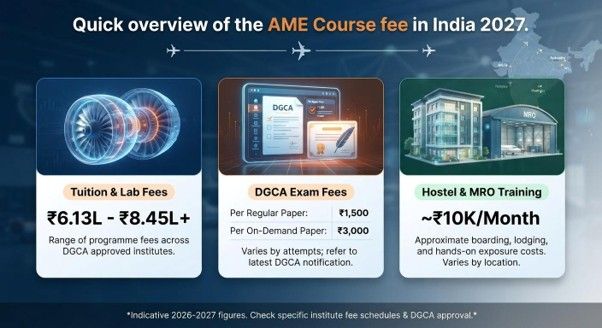
Below is an indicative comparison of published course fees, based on institute fee schedules (2026 and 2026–27).
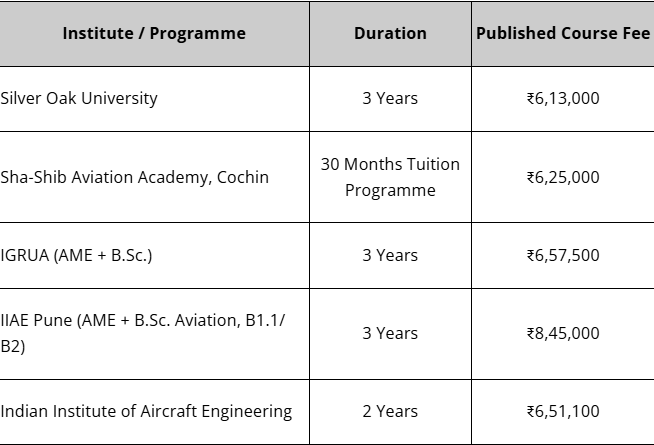
The figures reflect various programme formats and are not directly comparable. Some institutes include practical training in MRO, while others charge extra fees for the same. The amounts published are indicative and not all-inclusive 2027 prices.
It is important for students to understand the individual costs of the education so that a realistic budget can be drawn up.
Admission and Registration Fees
Typically when a student reserves a seat, they pay the admission fee(s) and the registration fee(s). These payments can cover application processing, student registration and student admission administration.
The amount that is refundable, partially refundable or non-refundable on admission may vary from institute to institute. Some will set admission charges based upon tuition fees, others will charge separately.
Students must always check the refund policy before paying.
Tuition and Laboratory Fees
Tuition fees are a significant portion of the costs of the Aircraft Maintenance Engineering course. These include laboratory sessions, academic support, technical subjects and classroom instruction.
AME students are taught in the following subjects:
- Aircraft maintenance practices
- Aerodynamics and aircraft structures
- Working knowledge of aircraft engines and propulsion systems
- Maintenance of electronic and electrical systems
- Aviation legislation
- Flight instruments and radio navigation systems of aircraft
If you're curious how these subjects translate into real work on the hangar floor, see what aircraft maintenance engineers do day to day.
The lab fees might be part of tuition or separate, as per the college.
Fees for Practical Training and MRO Training
AME is a practical profession, so it is essential that there is also some practical training. Students require exposure to an actual aircraft maintenance workshop, tools and maintenance procedures.
Aircraft Maintenance Trainee (MRO) training teaches students the workings of aircraft maintenance operations in professional aircraft organisations.
Certain institutes incorporate industry training in the advertised course fees. There are also providers that charge extra fees for practical sessions.
In Sha-Shib Aviation Academy's 2026 fee structure, ₹6,25,000 is given as the programme fee. It additionally lists practical training charges of about ₹1,20,000–₹1,40,000, plus 18% GST on those charges, for outsourced practical training.
Hence, students must check whether practical training is included when comparing two institutes.
DGCA Examination Fees
DGCA exam fees are an additional cost that a student would need to consider if they are seeking their AME licence. To understand the full process, read how to get an Aircraft Maintenance Engineer licence in India.
The published examination fees are as mentioned in the DGCA examination guide, as given below:
Examination Type Fee Per Paper Regular Online Examination
₹1,500 Online On-Demand Examination ₹3,000
The total examination fee will vary according to the number of papers attempted and whether the student needs to reattempt any papers. Candidates should refer to the latest DGCA notification for changes in examination fees.
Books, Uniforms and Study Materials
AME students should have technical books, study materials, laboratory equipment and suitable uniforms.
These costs can vary from institute to institute and may include:
- Aircraft maintenance textbooks
- Technical drawing and reference materials
- Laboratory coats and uniforms
- Safety equipment for workshop work
- Library and academic resources
Some colleges cover these costs in their fees and some colleges charge for them upfront.
Accommodation and Hostel Cost for AME Students
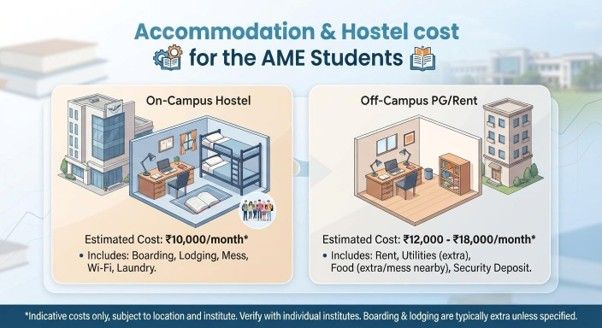
If students move to a different city, accommodation is an expense in addition to educational costs.
Hostel charges usually vary according to the location, type of accommodation, meals and the amenities available.
In IGRUA's 2026 AME advertisement, the cost of boarding and lodging is quoted at about ₹10,000/month. Over a 36-month duration, this would come to around ₹3,60,000, if the rate doesn't change over time.
Additional costs could include:
- Food/mess charges
- Local transportation
- Personal expenses
- Clothes and other everyday necessities
- Travel between home and the institute
Residential and living expenses can add up significantly to the total AME education budget.
Which AME College Is More Budget-Friendly, Government or Private?
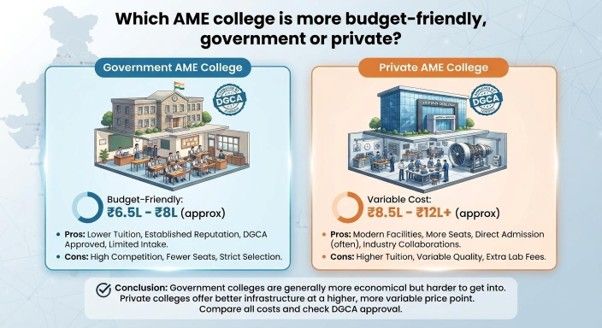
Students often compare government and private aviation institutes during their AME fee research.
Government-supported institutions may have competitive programme fees, but seats may be granted based on selection, and the number of places can be limited.
For instance, Indira Gandhi Rashtriya Uran Akademi (IGRUA), under the Ministry of Civil Aviation, advertised its integrated AME + B.Sc. programme for the 2026 course at ₹6,57,500 for 36 months. The advertised fee does not cover boarding and lodging, which are extra.
Private institutions also offer varied fee structures depending on infrastructure, practical training and academic collaborations.
The lowest tuition fee should not automatically be considered the best choice. Students should check DGCA approval, practical training facilities, access to aircraft, industry exposure and the payment structure.
B1.1 Mechanical vs B2 Avionics: Does the Course Fee Differ?
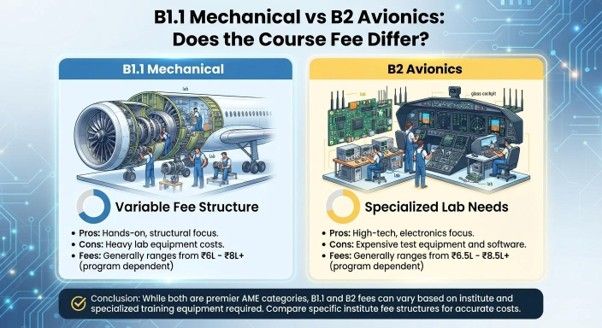
The two most common technical categories in an AME programme are B1.1 Mechanical and B2 Avionics.
- B1.1 Mechanical: Aircraft structures, engines, mechanical systems, hydraulics, landing gear and related maintenance.
- B2 Avionics: Aircraft electrical systems and instruments, communication, navigation and electronic equipment.
Course fees may differ between the two categories, depending on the training equipment, laboratory needs and practical facilities each requires.
Some institutes offer both categories at almost the same cost, while others price them differently. Students should request the specific fee for the category they wish to pursue.
Is an AME + B.Sc. Programme More Costly?
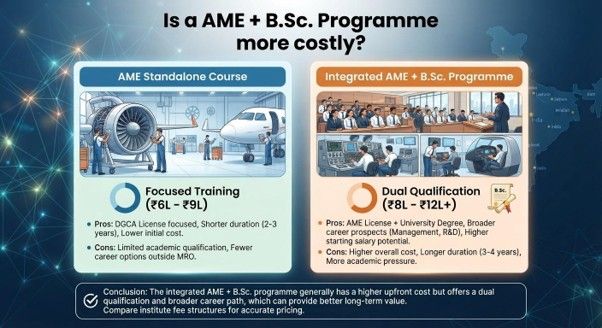
Certain aviation institutes provide integrated courses combining Aircraft Maintenance Engineering and a bachelor's degree.
Academic tuition and facilities, technical training and industry exposure can be part of these programmes.
For instance, IIAE Pune has quoted an overall programme fee of ₹8,45,000 for its 2026–2027 B1.1/B2 AME + B.Sc. Aviation programme, and it has published a training schedule including MRO or airline practical training charges.
An integrated programme may be priced higher than a stand-alone course, but students should evaluate the academic and training components before choosing.
You should also check whether items such as registration, books, uniforms and miscellaneous charges are listed separately from the advertised total.
How to Reduce AME Course Expenses
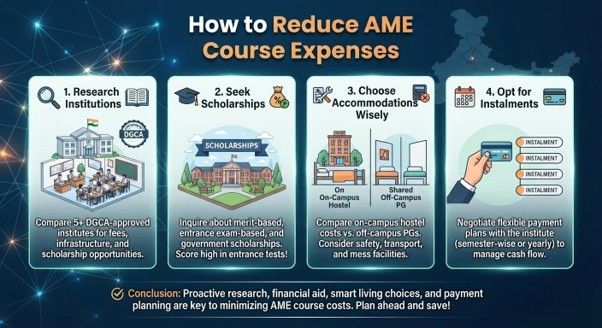
There are some simple steps students can take to budget their education properly.
- Compare several institutes: Get detailed fee structures from several DGCA-approved training institutes before choosing one.
- Review scholarships: Inquire about merit-based scholarships, entrance exam concessions and other financial aid.
- Choose accommodation carefully: Compare the institute hostel with approved accommodation nearby, taking safety and transportation into account.
- Understand payment modes: Look for institutes that accept instalments, by semester or by year, which makes financial planning easier.
- Watch for hidden costs: Check practical training, exam, book and uniform costs before admission.
A printed breakdown of the costs is preferable to oral statements made by admission counsellors.
Important Things to Check Before Paying AME Admission Fees
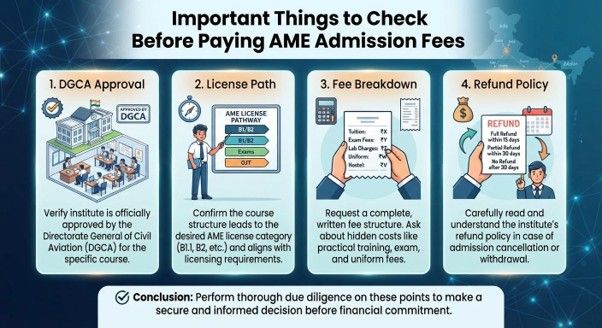
Before enrolling in an Aircraft Maintenance Engineering programme, students are advised to check the following:
- Whether the institute has the relevant DGCA approval for the advertised programme
- Whether the course provides the desired path toward an AME licence
- Whether B1.1 or B2 training is offered
- Whether in-service or airline training is included
- Whether DGCA exam fees are charged separately
- Whether hostel and food are included
- What happens if a student withdraws after admission
- Whether additional charges or taxes apply, and their exact amounts
Students should also be aware that completing an AME course does not by itself guarantee an AME licence from the DGCA. Other examinations, practical training, experience and licensing requirements must also be completed.
Frequently Asked Questions
What will be the AME fees in India in 2027? Some institutes charge around ₹6 lakh to ₹9 lakh as programme fees, as per the published 2026–2027 fee schedules. The overall amount varies according to the institute, the training type and additional costs.
Which is the most economical AME course in India? Students are advised to check government-supported institutions, scholarships and other affordable DGCA-approved training organisations. However, the lowest advertised fee may exclude practical training, accommodation and examination charges.
Do AME course fees include hostel? Not always. Hostel and mess charges are usually collected separately at many institutes. Students are advised to check the full accommodation fees prior to admission.
Is the DGCA exam fee part of the AME tuition fee? Typically, no. Students should confirm this with the institute. The examination fee payable to DGCA follows the applicable examination schedule.
Can students pay AME course fees in instalments? Yes. Some institutes allow payment on a semester-by-semester or annual basis. Payment arrangements vary by institute.
Is the AME course worth the fees? AME can be a suitable career choice for students interested in aircraft technology, engineering and aviation safety. But students should consider the overall cost of education, the licensing process and future job prospects before investing. For a broader view, read about starting a career in aviation maintenance.
Conclusion
The AME course fee in India for 2027 depends on the type of institute, the licence category and the practical training included in the programme. Students should always consider the following items when judging the cost of any advertised course: tuition, fees, MRO training, DGCA exams, books, uniforms and accommodation.
With a clear fee structure and strong hands-on training opportunities, a student can make a more informed choice by selecting a DGCA-approved institute. Always ask for a full written breakdown of costs before paying the admission fee, and check which licences are required before payment.
If you’re comparing options and want a clear picture of what the programme involves, you can explore the AME course at Vision Institute of Aviation. Check the syllabus, training approach and fee structure there, and get in touch with the team for a written cost breakdown before you decide.