What Do Aircraft Maintenance Engineers Do Daily?
Learn what aircraft maintenance engineers do daily, their responsibilities, the aircraft inspection process, and the skills required for a career in aviation maintenance in India.
An aircraft maintenance engineer's daily work involves examining aircraft systems, identifying technical issues, performing scheduled maintenance, replacing components, and ensuring every maintenance activity follows strict aviation safety standards. They are responsible for inspecting, maintaining, troubleshooting, repairing, and certifying aircraft before they return to service.
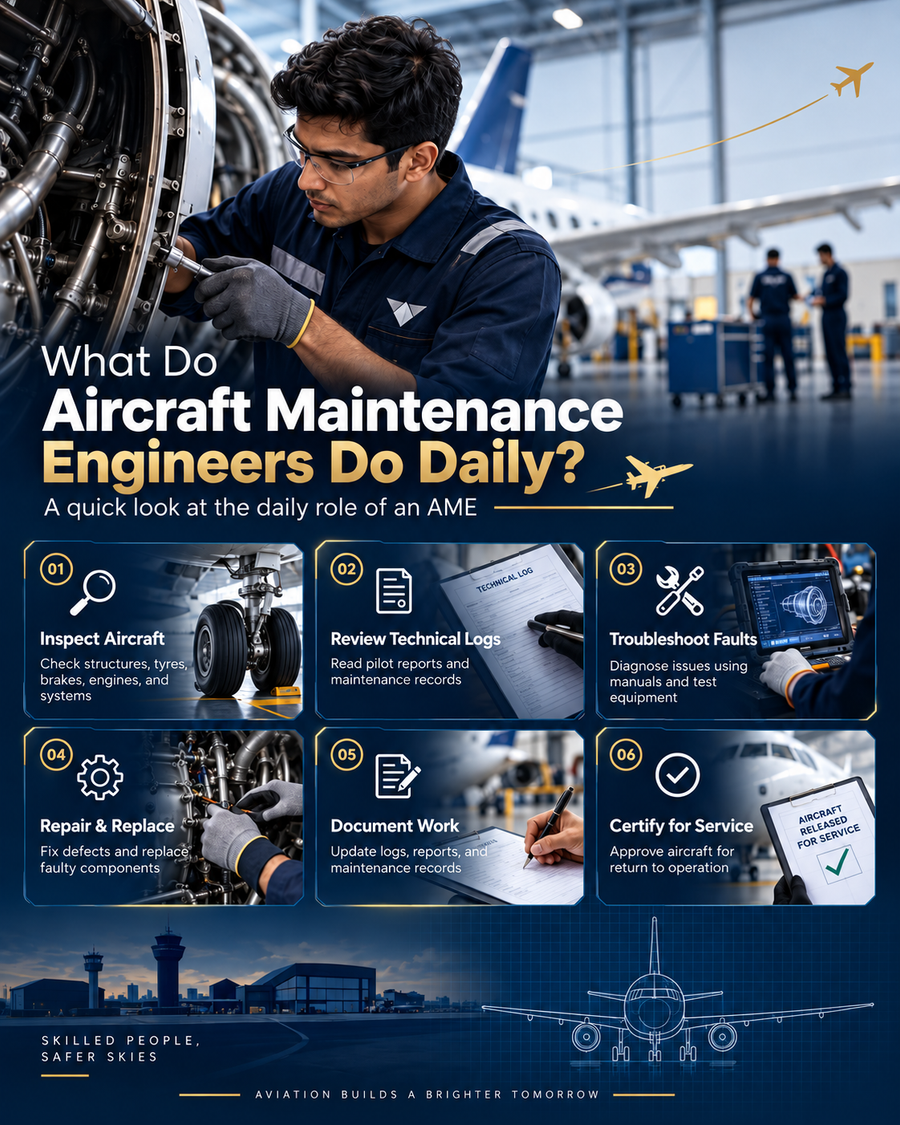
The role of an AME can be understood through six core responsibilities that define their day-to-day work:
- Inspect: Identify wear, leaks, cracks, and technical faults before they develop into larger safety issues.
- Maintain: Perform scheduled inspections, routine servicing, component checks, and preventive maintenance activities to keep aircraft systems reliable and operating efficiently.
- Troubleshoot: Diagnose technical issues using aircraft manuals, testing equipment, and engineering knowledge to identify faults and determine the corrective action.
- Fix: Repair or replace faulty components, from worn tyres and mechanical parts to electrical and avionics units.
- Document: Record every maintenance task accurately so the work remains traceable, compliant, and properly logged throughout the aircraft’s operational history.
- Certify: Sign the Certificate of Release to Service (CRS) after completing the required checks and maintenance activities, confirming that the aircraft is released back into service according to approved procedures.
These responsibilities highlight that an Aircraft Maintenance Engineer’s role extends beyond repairing aircraft.
When people think about careers in aviation, they usually imagine pilots flying aircraft. However, behind every safe flight, there is a team of highly skilled aviation professionals who ensure that the aircraft is airworthy, reliable, and safe to operate.
Students planning a career in aviation after Class 12 can benefit from understanding the daily duties, responsibilities, and career opportunities associated with becoming an Aircraft Maintenance Engineer in India.
Who is an Aircraft Maintenance Engineer?
An Aircraft Maintenance Engineer (AME) is a licensed aviation professional who maintains aircraft safety, reliability, and compliance with aviation regulations through inspections, repairs, and maintenance activities.
Before an aircraft is allowed to fly, it must undergo multiple inspections and maintenance checks. Aircraft Maintenance Engineers examine the aircraft, identify defects, perform necessary repairs, and certify that the aircraft meets required safety standards.
Aircraft Maintenance Engineers work according to approved maintenance procedures provided by:
- Aircraft manufacturers
- Airlines
- Maintenance organisations
- Aviation regulatory authorities such as DGCA (Directorate General of Civil Aviation)
What are the Different Types of Aircraft Maintenance Engineers?
Aircraft Maintenance Engineers are generally divided into different categories based on their licence and specialization.
Category Specialisation
B1 Mechanical Aircraft structure, engines, mechanical systems
B2 Avionics Electrical and electronic aircraft systems
Category A Line maintenance certification tasks
Category C Base maintenance certification responsibilities
In India, students usually complete a DGCA-approved Aircraft Maintenance Engineering (AME) course and meet the required examination and practical experience requirements to obtain their licence.
What Does an Aircraft Maintenance Engineer Do Daily?
An Aircraft Maintenance Engineer (AME) performs aircraft inspections, maintenance checks, repairs, troubleshooting, and documentation tasks every day to ensure aircraft safety and operational readiness.
Their daily activities depend on the aircraft type, maintenance schedule, airline operations, and whether they work in an airline, Maintenance Repair Organisation (MRO), or aviation maintenance facility.
A typical day of an Aircraft Maintenance Engineer may include:
Daily Activity Description
Aircraft Inspection Checking aircraft components, systems, and structures for defects or damage.
Maintenance Tasks Performing scheduled and unscheduled maintenance activities.
Troubleshooting Identifying and fixing technical problems in aircraft systems.
Component Replacement Removing and installing faulty aircraft parts.
Documentation Maintaining maintenance records and technical reports.
Safety Checks Ensuring aircraft comply with aviation regulations.
Team Coordination Working with pilots, technicians, engineers, and ground staff.
A Day in the Life of an Aircraft Maintenance Engineer
The daily routine of an Aircraft Maintenance Engineer begins before the aircraft takes off and continues throughout its operational cycle.
Let’s understand their daily responsibilities step-by-step.
1. Reviewing Aircraft Maintenance Records Before Starting Work
The day usually begins with reviewing aircraft technical records and maintenance requirements.
Before touching an aircraft, AMEs analyse important information such as:
- Previous aircraft maintenance logbooks for technical issues
- Aircraft flight hours and cycles
- Scheduled inspection requirements
- Manufacturer maintenance instructions
Aircraft maintenance is highly organised and documentation-driven. Engineers cannot simply repair a component based on assumptions; every action must follow approved aviation procedures.
In India, aircraft maintenance activities are regulated by the Directorate General of Civil Aviation (DGCA).
For example, if an aircraft has a repeated warning related to a hydraulic system, the AME reviews previous reports, identifies possible causes, and follows the approved troubleshooting process.
This systematic approach makes sure that aircraft problems are solved correctly rather than temporarily fixed.
2. Conducting Pre-Flight Aircraft Inspections
One of the most important responsibilities of an Aircraft Maintenance Engineer is conducting scheduled aircraft inspections before operation.
Before an aircraft leaves the ground, engineers examine different aircraft systems to identify any possible safety concerns.
These inspections may include checking:
- Aircraft exterior checks, including signs of wear, damage, or leaks
- Landing gear systems
- Engine components
- Hydraulic systems
- Electrical systems
- Flight control systems
- Fuel systems
- Cabin equipment
The purpose of these inspections is to identify problems before they affect aircraft operations.
A small technical issue detected during inspection can prevent a major safety concern later.
3. Troubleshooting Aircraft Technical Problems
Aircraft are highly complex machines containing millions of parts working together. Even advanced aircraft may experience technical issues, and troubleshooting is one of the most important skills of an AME.
It includes:
- Fixing faults
- Servicing parts
For example:
If the aircraft cockpit displays an abnormal warning, an AME investigates whether the issue is caused by a sensor, wiring problem, computer system, or another component.
This requires strong technical knowledge and problem-solving ability.
4. Performing Scheduled Aircraft Maintenance Checks
Aircraft maintenance is not only performed when something breaks. Aircraft undergo regular preventive maintenance based on flight hours, flight cycles, and manufacturer recommendations.
These checks help identify possible issues before they become serious.
Aircraft Maintenance Engineers perform different levels of maintenance checks, including:
Maintenance Check Description
Transit Check Quick inspection performed between flights
Daily Check Routine inspection to ensure aircraft readiness
A Check Detailed inspection performed after specific flight hours
C Check Extensive maintenance requiring aircraft downtime
Heavy Maintenance Check Complete aircraft inspection involving major systems
During these checks, AMEs inspect aircraft components, replace parts when required, perform functional tests, and record all maintenance activities.
5. Maintaining Aircraft Engines and Mechanical Systems
Aircraft engines are among the most critical systems of an aircraft. Any issue with engine performance can directly impact aircraft operation.
Aircraft Maintenance Engineers specialising in mechanical systems inspect:
- Engines
- Landing gear
- Hydraulic systems
- Pneumatic systems
- Fuel systems
- Flight control systems
This area is commonly associated with the B1 Mechanical Aircraft Maintenance Licence category.
A B1 AME requires a strong understanding of aircraft mechanics, materials, engines, and mechanical systems.
6. Working on Aircraft Avionics and Electronic Systems
Modern aircraft rely heavily on advanced electronics, computers, and automated systems.
Avionics Aircraft Maintenance Engineers work on:
- Communication systems
- Navigation systems
- Radar equipment
- Autopilot systems
- Flight management systems
- Electrical systems
This area comes under the B2 Avionics Aircraft Maintenance Licence category.
With aircraft becoming increasingly technology-driven, avionics specialists play an important role in modern aviation maintenance.
7. Completing Aircraft Maintenance Documentation
Aircraft Maintenance Engineers maintain detailed records of all maintenance activities performed on an aircraft. This includes:
- Updating maintenance logs, inspection reports, defect records, and component replacement details
- Issuing the required clearance certification to confirm that the aircraft is safe and approved for departure.
An authorised Aircraft Maintenance Engineer may sign the Certificate of Release to Service (CRS), the document that confirms the aircraft has been maintained according to approved procedures and is released back into service for operation.
Aviation follows the principle:
"If it is not documented, it is considered not completed."
Proper documentation helps airlines, regulators, and maintenance teams maintain complete aircraft history.
8. Coordinating With Pilots and Aviation Teams
Aircraft maintenance is a collaborative process that requires effective coordination between different aviation professionals.
Aircraft Maintenance Engineers (AMEs) regularly work with pilots, aircraft technicians, airline operations teams, maintenance planners, and ground handling teams.
Before departure, pilots may discuss technical information with maintenance teams to understand aircraft status.
This collaboration ensures safe and efficient aircraft operations.
Where Do Aircraft Maintenance Engineers Work? Line Maintenance vs Base Maintenance
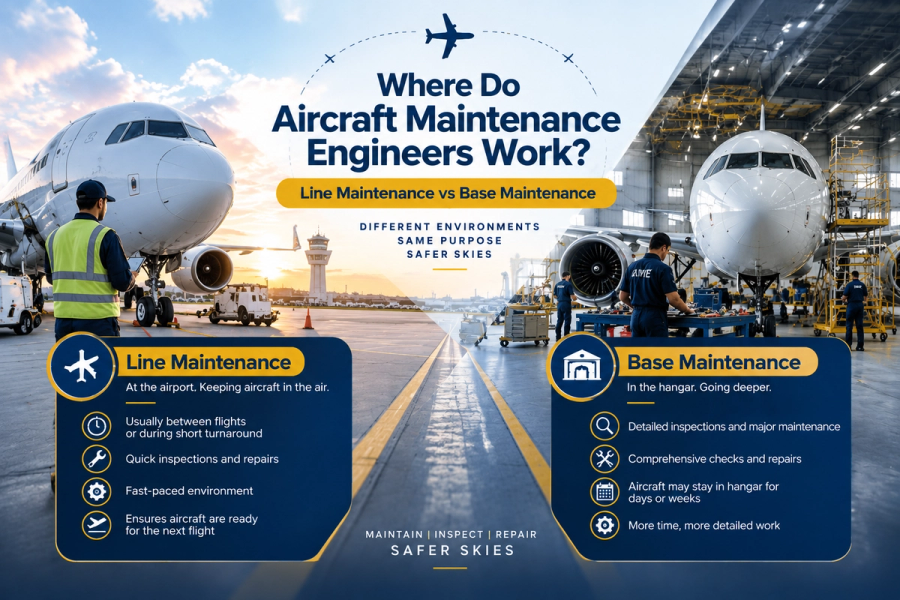
Aircraft Maintenance Engineers work in different aviation environments depending on their role, aircraft type, and maintenance requirements. The two primary areas where AMEs work are line maintenance and base maintenance.
While both involve maintaining aircraft safety and airworthiness, the nature of work, working environment, and maintenance activities are different.
Aircraft Maintenance Engineers in Line Maintenance
Line maintenance refers to aircraft maintenance activities performed at airports, usually between flights or during short aircraft turnaround periods. The primary goal of line maintenance is to ensure that aircraft remain operational and can safely continue their scheduled flights.
Aircraft Maintenance Engineers working in line maintenance often work in fast-paced airport environments where quick decision-making and efficient troubleshooting are essential.
For example, if an aircraft develops a technical issue before departure, line maintenance engineers investigate the problem, perform necessary repairs, and complete the required checks before the aircraft returns to operation.
Aircraft Maintenance Engineers in Base Maintenance
Base maintenance involves detailed aircraft inspections and major maintenance activities performed inside specialised aircraft hangars.
Unlike line maintenance, where the focus is on keeping aircraft operational between flights, base maintenance involves deeper inspections and repairs that require more time and extensive technical work.
During base maintenance, aircraft may remain inside hangars for several days or weeks while engineers carry out comprehensive inspections and repairs.
What Skills are Required to Become a Successful Aircraft Maintenance Engineer?
A successful Aircraft Maintenance Engineer needs a combination of technical knowledge, practical skills, and professional discipline.
Important skills include:
Skill Why It Matters
Technical Knowledge Helps understand aircraft systems and maintenance procedures.
Problem-Solving Ability Required for troubleshooting technical issues.
Attention to Detail Essential for identifying small defects.
Safety Awareness Aviation requires strict safety standards.
Communication Skills Helps coordinate with aviation teams.
Discipline Maintenance work requires following procedures accurately.
Continuous Learning Aircraft technology keeps evolving.
Why Choose Aircraft Maintenance Engineering as a Career?
The aviation industry requires skilled professionals who can maintain increasingly advanced aircraft.
A career as an Aircraft Maintenance Engineer offers:
- Opportunity to work with aircraft technology
- Career opportunities in airlines and MRO companies
- International aviation exposure
- Technical growth opportunities
- A respected role in aviation safety
Students who enjoy engineering, technology, and aviation, AME course can be a highly rewarding career option.
Build Your Aviation Career With Vision Institute of Aviation
Aviation safety begins long before an aircraft leaves the runway. Behind every successful flight is a team of Aircraft Maintenance Engineers who ensure that every aircraft component works exactly as it should.
The daily responsibilities of an AME require technical knowledge, attention to detail, and a strong commitment to aviation safety. This makes Aircraft Maintenance Engineering a rewarding career choice for individuals who are interested in aircraft technology, engineering, and being part of one of the world’s most important industries.
Building a successful career in aircraft maintenance begins with the right training, practical exposure, and a strong understanding of aviation standards. Vision Institute of Aviation provides aviation-focused training designed to help students develop the technical skills, practical knowledge, and professional foundation required to progress in the field of Aircraft Maintenance Engineering.
A career as an Aircraft Maintenance Engineer offers the opportunity to work with advanced aircraft systems and contribute to safer air travel every day. Students aspiring to become part of this essential aviation profession can begin their journey with Vision Institute of Aviation and take a step toward a future in aircraft maintenance.