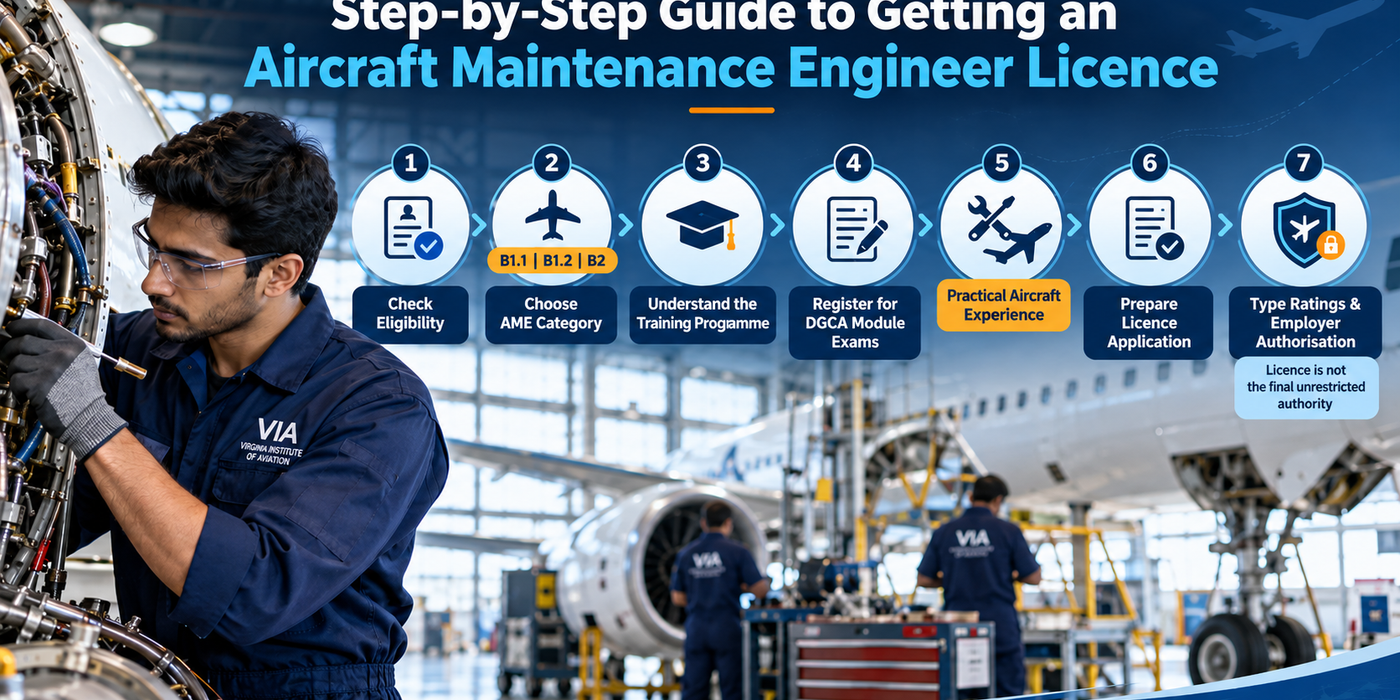
How to Get an Aircraft Maintenance Engineer Licence in India
Learn how to get an aircraft maintenance engineer licence in India, including DGCA eligibility, module exams, practical experience and application steps.
Getting an Aircraft Maintenance Engineer licence in India requires you to meet the eligibility requirements, pass the applicable DGCA module examinations, complete acceptable practical maintenance experience and apply for the appropriate licence category. Completing an AME course alone does not give you the licence or permission to certify every aircraft.
Students planning their future after Class 12 need to understand this distinction. Your choice of training should help you progress towards licensing, with a clear understanding of the examinations, experience and additional qualifications involved.
Here is how the process works and what to check before committing to a programme.
What is an Aircraft Maintenance Engineer Licence?
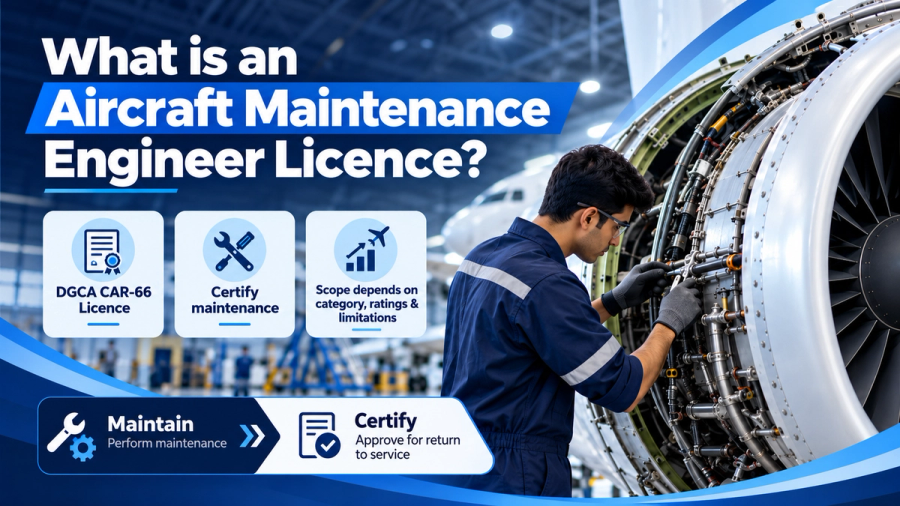
An Aircraft Maintenance Engineer (AME) licence is a professional licence issued by India’s Directorate General of Civil Aviation (DGCA) under CAR-66. It provides the licensing basis for certifying aircraft maintenance.
The key distinction is between carrying out maintenance and certifying the completed work. Certification means confirming that the specified maintenance has been completed in accordance with the applicable requirements. Appropriately authorised certifying staff can issue a certificate of release to service covering that work.
An AME licence does not give its holder unrestricted authority to certify every aircraft or maintenance task. The permitted scope depends on the licence category, relevant aircraft ratings and any limitations.
If you are still exploring the profession, understanding the daily responsibilities of an aircraft maintenance engineer can help you understand the work and decide whether it matches your interests.
Step-by-Step Guide to Getting an Aircraft Maintenance Engineer Licence
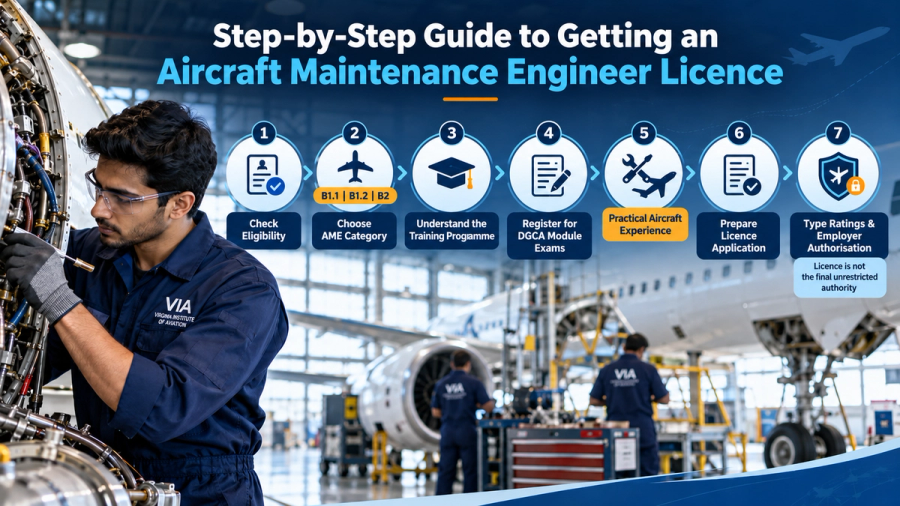
- Check Your Academic and Age Eligibility
The standard academic requirement is 10+2 with Physics, Chemistry and Mathematics from a recognised board or university, or an accepted equivalent. DGCA’s AME examination FAQs explain the applicable qualification and equivalence documentation requirements.
Applicants must be at least 18 years old when the licence is issued. This requirement is separate from an institute’s own admission criteria.
If you hold a diploma or another qualification, confirm its equivalence before paying any admission fees. Share your certificates and subject details with the institute or relevant authority instead of relying on a general claim that “all engineering diplomas are accepted.”
A training institute may also set its own requirements, such as minimum marks, entrance assessments or additional admission conditions. Ask clearly which requirements come from DGCA and which are specific to the institute.
- Choose the AME Licence Category That Matches Your Career Interests
Your chosen licence category determines the technical area you will study and the type of maintenance work you may eventually be qualified to certify.
Three common pathways for students exploring mechanical and avionics careers are:
Category Main area
B1.1 Mechanical maintenance of turbine-engine aeroplanes
B1.2 Mechanical maintenance of piston-engine aeroplanes
B2 Avionics and electrical systems
These are simplified descriptions and do not represent the complete scope of certification privileges. The detailed licence categories and requirements are set out in DGCA CAR-66.
Before choosing a category, ask to review the subjects, workshop activities and practical training opportunities available for each pathway. Consider whether your interests are stronger in aircraft structures and engines or in electrical systems, avionics, instruments and fault diagnosis.
Avoid choosing a category simply because someone describes it as the "best". A better decision considers your interests, career goals and the quality of training available.
- Understand What Your AME Training Programme Provides
A structured basic maintenance training programme can help you develop the technical knowledge and practical skills required for your chosen AME category. However, it is important to understand exactly what the programme provides and what you will still need to complete afterwards.
Under CAR-147 (Basic), approved basic training includes defined knowledge, practical training and assessment requirements. A Certificate of Recognition documents the relevant training achievement. It is not the AME licence.
Before enrolling, ask the institute to provide the following in writing:
- Its current DGCA approval certificate and the approved scope for the specific training location.
- The AME licence category or subcategory covered by the programme.
- The certificate or qualification you will receive after successfully completing the course.
- Details of the practical training and hands-on experience arrangements.
- A clear explanation of the remaining requirements for obtaining your DGCA AME licence after completing the programme.
Airline logos, aircraft photographs or marketing claims do not explain your licensing pathway. Ask for documents that clearly show how the programme relates to your intended AME licence category.
- Register for the Applicable DGCA AME Module Examinations
AME knowledge is assessed through modules relevant to the licence category. Candidates use the DGCA Pariksha portal for examination registration and applications.
You will need an AME Computer Number, which serves as your permanent identifier for examination records. Follow the latest DGCA user manual and examination notices for registration procedures, documentation, fees and application dates.
Create a study tracker covering:
- The modules applicable to your licence category.
- Your planned examination sessions.
- Results and modules requiring another attempt.
- The syllabus revision used for preparation.
Check your study material against the applicable Indian syllabus. Aviation legislation preparation, in particular, should reflect current Indian requirements. Overseas notes, old question banks or previous examination papers should not be your only source of preparation.
DGCA’s February 2026 examination notice specifically identified the CAR-66 syllabus revision for that examination session. This shows why candidates should always check current notices.
- Build and Document Practical Aircraft Maintenance Experience
Practical maintenance experience is a separate licensing requirement. Completing classroom training and passing the module examinations do not replace the required hands-on experience.
CAR-66 specifies different practical experience periods depending on the licence category and the applicant’s previous training or qualifications:
These periods refer to practical maintenance experience on operating aircraft and not the total duration of an AME course. The relevance of the experience, range of tasks performed, recency of experience and supporting records also matter.
Before accepting a practical experience opportunity, ask what maintenance activities you will perform, who will supervise you and how your work will be recorded and verified.
Your records should clearly show what you actually did. An entry stating only “worked in the hangar” provides little useful evidence. A dated record identifying the aircraft, maintenance task, your level of involvement and the appropriate verification is much more useful.
Do not wait until the end of your placement to organise these records. Maintain them consistently from the beginning.
- Prepare Your DGCA AME Licence Application
Once you have completed the applicable requirements, prepare your licence application according to the current DGCA instructions.
Organise your supporting evidence into clear groups:
- Identity and educational documents.
- DGCA examination records.
- Training certificates.
- Practical maintenance experience records and supporting confirmations.
- Any additional documents required for your licence category.
Use this only as a preparation checklist. The current DGCA application instructions should determine the exact documents you submit.
Check that your name, dates, licence category and other important details are consistent across all records. If something is inconsistent, address it before submission. Keep copies of the application, payment acknowledgement and any correspondence.
- Understand Aircraft Type Ratings and Employer Certification Authorisation
Obtaining the basic AME licence is not necessarily the final stage of becoming authorised to certify maintenance on a particular aircraft.
B1 and B2 licence holders working on applicable Group 1 aircraft may need aircraft-specific type training and the required assessment before the relevant aircraft type can be endorsed on their licence. The first aircraft type endorsement within a category or subcategory may also require applicable on-the-job training.
This aircraft-specific stage should not be confused with the basic experience requirement.
Within a CAR-145 approved maintenance organisation, certification privileges also depend on the organisation’s own certification authorisation. The employer assesses the engineer’s competence and defines the scope of work they are permitted to certify under the CAR-145 certifying staff requirements.
Therefore, holding an AME licence does not provide unrestricted authority to certify maintenance across every aircraft type or an airline’s entire fleet. Your privileges depend on the licence category, aircraft type ratings, applicable limitations and the certification authorisation granted by the maintenance organisation.
How Long Does It Take to Become a Licensed AME?
There is no single timeline that applies to every aspiring Aircraft Maintenance Engineer. The total time depends on your starting qualifications, chosen AME licence category, examination progress, practical maintenance experience and access to aircraft-specific training where required.
When comparing AME institutes, ask for a timeline divided into three stages:
- Basic training programme: What knowledge training, practical training and assessments will you complete while enrolled?
- DGCA licensing requirements: Which module examinations, practical experience or documentation requirements may still remain after the course?
- Aircraft-specific and employer requirements: Will your intended role require aircraft type training, on-the-job training or additional certification authorisation?
This is more useful than a single promise of becoming an AME in a fixed number of years.
VIA’s guide to starting a career in aviation maintenance explains the different entry routes and career-planning considerations in more detail.
What Should You Budget for Beyond AME Course Fees?
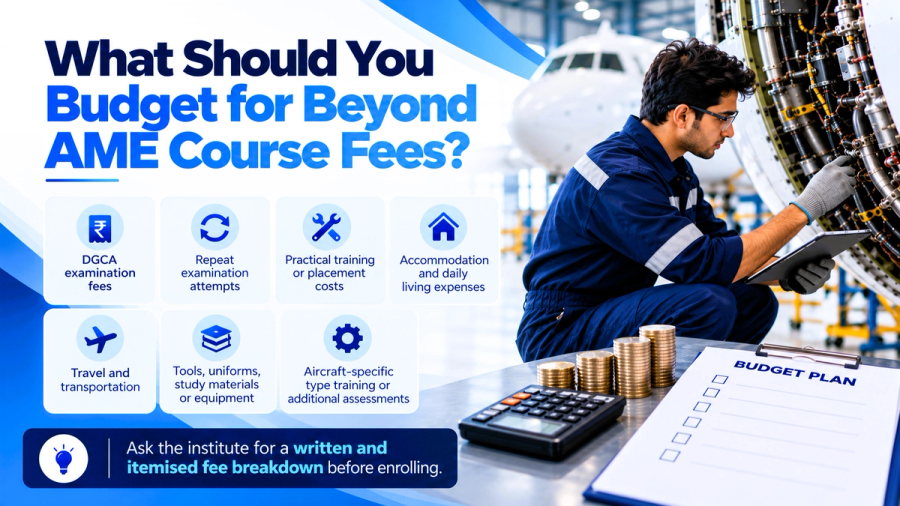
Start by asking the institute for a written and itemised fee breakdown. The advertised course fee may not include every expense involved in completing your AME training and licensing pathway.
Confirm whether the quoted amount includes:
- DGCA examination fees.
- Fees for repeat examination attempts.
- Practical training or placement-related costs.
- Accommodation and daily living expenses.
- Travel and transportation.
- Tools, uniforms, study materials or equipment.
- Any later aircraft-specific type training or additional assessments.
Also ask what happens if practical training is delayed, an examination must be repeated or your training extends beyond the original schedule. These situations can create additional costs that may not be obvious at the time of admission.
Parents may find one question particularly useful:
“What exactly will my child have completed when this fee has been paid, and which requirements could still involve additional costs?”
Keep the institute’s written response with your admission documents. It gives you a much clearer basis for comparing AME programmes than looking only at the headline tuition fee.
Plan Your AME Training with VIA
Vision Institute of Aviation’s Aircraft Maintenance Engineering programme describes a two-year, four-semester structure covering mechanical and avionics streams, with preparation for the applicable DGCA modular examinations.
Use your admissions discussion to understand how the programme fits your intended AME licence category, practical maintenance experience requirements and the licensing milestones you may still need to complete after the course.
Before enrolling, ask VIA to explain the full pathway in writing, including the training covered, practical arrangements, examinations, expected completion stages and any additional costs.
Contact VIA’s admissions team to discuss your qualifications and request a current fee breakdown and a written training pathway based on your intended AME category.
Common Questions About Getting an AME Licence
Can I Apply Without Joining an AME Institute?
DGCA’s examination system includes general and private applicant categories as well as students enrolled with approved basic training organisations. However, examination registration does not remove the knowledge, experience or other licensing requirements.
If considering this route, establish how you will obtain suitable experience before committing to an examination-only plan.
Does an Aeronautical Engineering Degree Automatically Give Me an AME Licence?
No. A degree and an AME licence are different qualifications. A degree may be relevant to your licensing pathway, but it does not automatically grant maintenance certification privileges.
Does an AME Course Guarantee an Airline Job?
No. Training, licensing and recruitment are separate processes. Ask institutes to explain their career support precisely, including whether they provide interview preparation, placement assistance or access to vacancies.