Aircraft Maintenance Course in India: Eligibility, Fees and BSc Options
Get a complete overview of aircraft maintenance courses in India, including eligibility, subjects, fees, and career options.
Aircraft Maintenance Course in India: Eligibility, Fees and BSc Options
Choosing an aircraft maintenance course in India can become confusing when different institutes advertise AME training, BSc degrees, and combined programmes. These options may cover related subjects, but they do not necessarily lead to the same qualification, licensing requirements, and career opportunities.
An Aircraft Maintenance Engineering (AME) training programme supports a maintenance licensing pathway. A Bachelor of Science (BSc) is an academic degree awarded by a university. Some programmes combine both, while a Directorate General of Civil Aviation (DGCA) licence requires candidates to meet separate regulatory requirements.
Understanding these differences helps you choose a course that matches your career plans and your family’s investment.
What is an Aircraft Maintenance Course?
An aircraft maintenance course introduces students to aircraft systems, inspection procedures, maintenance practices, and technical documentation. The emphasis is on understanding how aircraft remain serviceable and how maintenance work is performed correctly.
Approved basic maintenance training includes theoretical learning, practical training, examinations, and assessments under the DGCA’s CAR-147 Basic framework.
Students should expect more than classroom lectures. Reading technical instructions, using tools carefully, identifying components, and documenting work are important parts of learning the profession.
VIA’s guide to the daily responsibilities of an aircraft maintenance engineer offers a closer look at the work behind this career.
Which Aircraft Maintenance Course Should You Choose?
Start by identifying the qualification you want to earn and the career you plan to pursue. Course titles alone can be misleading, as AME training, BSc programmes and combined courses may differ in their academic awards, DGCA licensing pathways and career opportunities.
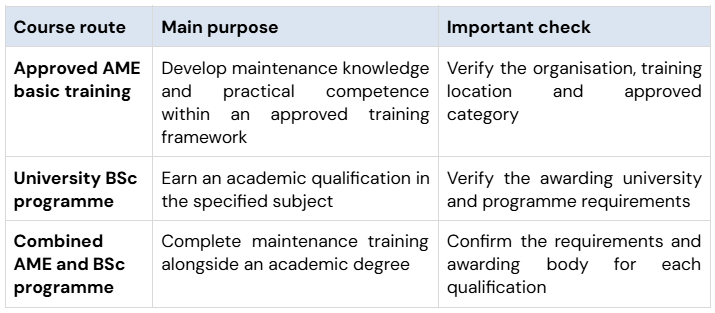
A training certificate, university degree and aircraft maintenance licence serve different purposes. Before enrolling, ask the institute to explain exactly which qualification you will receive and how it relates to your intended career.
Should You Choose Mechanical or Avionics AME Training?
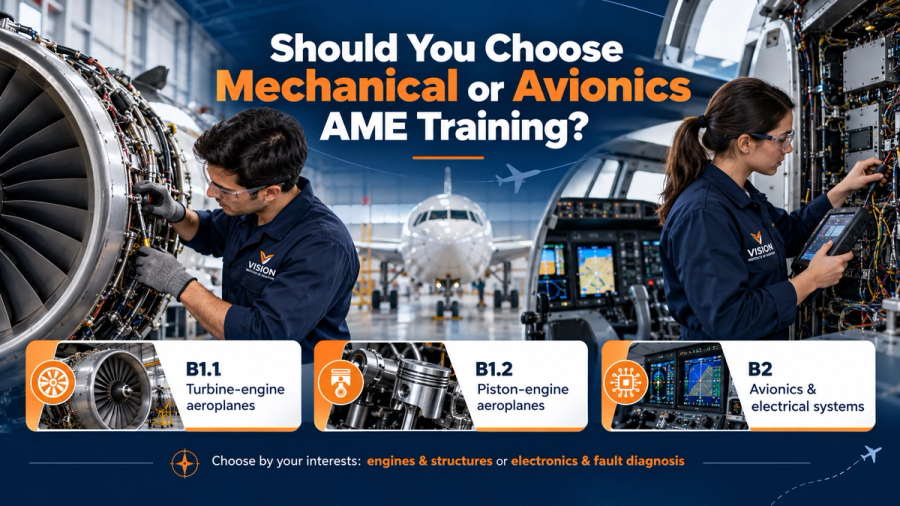
Common aircraft maintenance licence categories include:
- B1.1: Mechanical maintenance of turbine-engine aeroplanes.
- B1.2: Mechanical maintenance of piston-engine aeroplanes.
- B2: Avionics and electrical systems.
These categories are defined within DGCA CAR-66. Your choice influences the technical knowledge, practical experience and licensing pathway relevant to your career.
Review the syllabus and practical facilities available for each option before deciding. If you are interested in engines, aircraft structures and mechanical systems, B1 training may suit your interests. If you prefer electronics, instruments, electrical systems and fault diagnosis, B2 may be worth considering.
Aircraft Maintenance Course Eligibility in India
The DGCA’s AME examination guidance specifies 10+2 with Physics, Chemistry and Mathematics from a recognised board or university, or an equivalent qualification, for AME candidate registration.
Admission criteria can include additional institute or university conditions. Minimum marks, selection procedures and document requirements should therefore be checked against the particular programme.
An engineering diploma should not be assumed eligible simply because it contains the word “engineering”. The applicable equivalence conditions and supporting documents matter.
The minimum age for an AME licence is 18 years under CAR-66. This is a licence requirement, distinct from the admission age specified by a training provider.
Students considering a BSc must also meet the university’s admission rules. Eligibility for DGCA AME examinations does not automatically establish eligibility for every BSc programme.
What Subjects Do You Study in an Aircraft Maintenance Course?
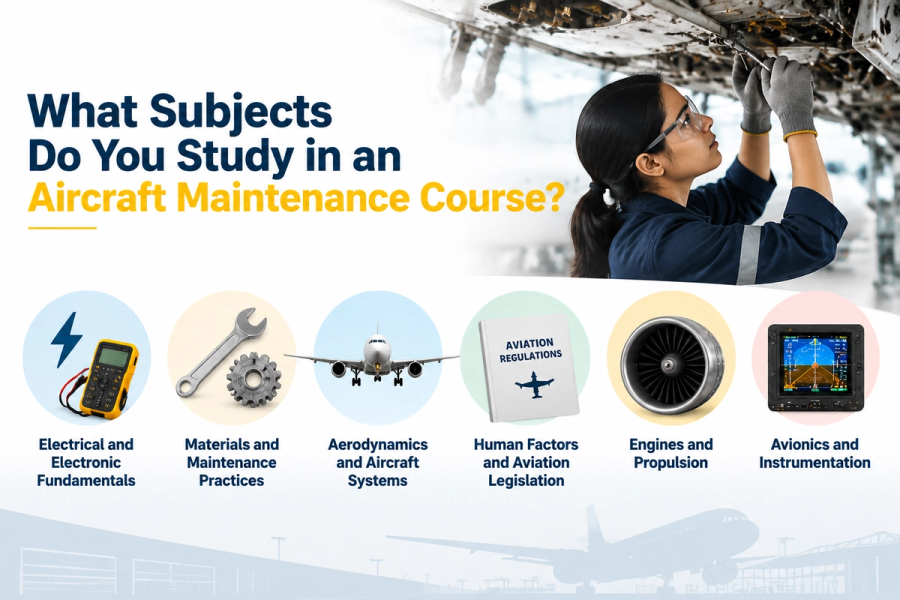
The subjects covered in an aircraft maintenance course in India depend on your chosen qualification and training category, such as AME B1.1, B1.2, or B2. The curriculum combines theoretical knowledge with practical skills relevant to aircraft maintenance.
Common subject areas include:
- Electrical and electronic fundamentals
- Materials and maintenance practices
- Aerodynamics and aircraft systems
- Human factors and aviation legislation
- Engines and propulsion
- Avionics and instrumentation
The applicable knowledge requirements are set out in DGCA CAR-66. A university degree or combined programme may include additional academic subjects, projects and assessments beyond the AME licensing curriculum.
During a campus visit, ask how lessons connect with practical tasks. A useful explanation should show what students learn, what they practise and how their competence is assessed.
Practical training should also be described precisely. Workshop exercises, aircraft visits and maintenance experience on operating aircraft are different activities. Ask which activities the programme includes and how each is recorded.
How Long is an Aircraft Maintenance Course?
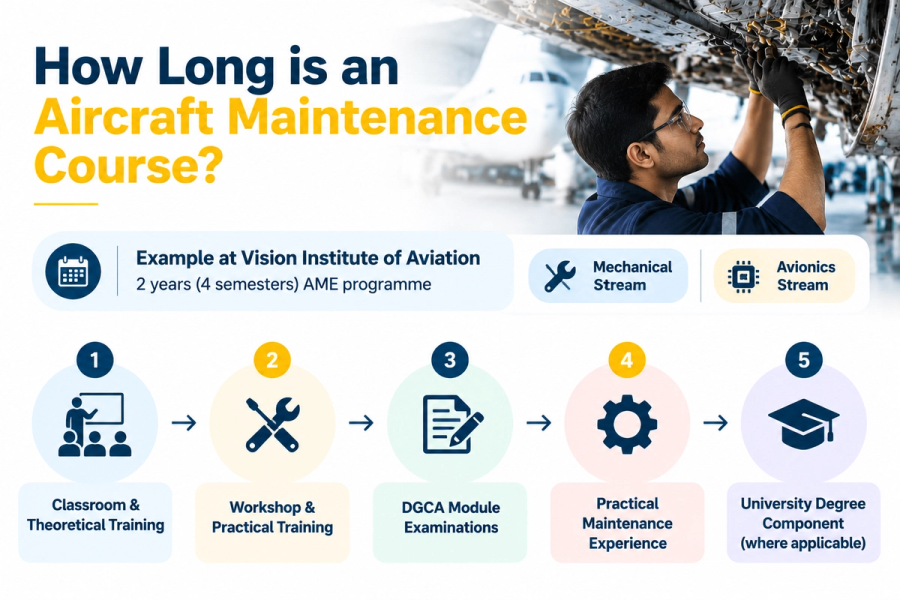
The duration of an aircraft maintenance course in India depends on the qualification, training structure, and institute you choose. AME training programmes, university degree courses and combined programmes may follow different schedules.
Vision Institute of Aviation’s published Aircraft Maintenance Engineering course describes a two-year, four-semester programme with mechanical and avionics streams. University degree programmes follow their own academic schedules.
However, completing the advertised course duration does not necessarily mean you have obtained your DGCA AME licence. You may still need to complete applicable module examinations, qualifying practical maintenance experience, and any additional requirements relevant to your licensing pathway.
Before enrolling, ask the institute to provide separate timelines for:
- Classroom and theoretical training.
- Workshop and practical training.
- DGCA module examinations.
- Required practical maintenance experience.
- Any university degree component, where applicable.
Comparing these stages will help you understand the total commitment involved and distinguish the duration of a training programme from the time needed to meet the requirements for an AME licence.
How Does Aircraft Maintenance Engineering Become a BSc?
AME training does not automatically become a BSc degree. A student earns a Bachelor of Science (BSc) degree by enrolling in a valid university programme and completing its academic requirements.
The connection between AME training and a BSc degree usually arises when an institution offers both qualifications through a combined programme. Although the subjects may overlap, the academic degree and the aircraft maintenance training qualification remain distinct.
Combined AME and BSc Programmes
A verified example is Jamia Millia Islamia’s BSc Aeronautics programme. Its programme document describes a BSc awarded by the university alongside an AME Certificate of Recognition issued by Indocopters under its CAR-147 Basic training arrangement.
The distinction matters: the academic award is a degree, while the maintenance training award is a Certificate of Recognition. Neither should be described as automatically granting an AME licence.
Students comparing combined programmes should confirm the following details:
- Which university will issue the degree?
- What qualification will appear on your degree certificate?
- Which organisation provides the AME training, and what is its current approval scope?
- Is registration for the degree included in the programme?
- Which academic assessments, DGCA examinations, and practical experience requirements apply?
- Does the quoted amount cover both the degree and maintenance training?
Can You Get a BSc Degree After Completing AME Training?
You may be able to pursue a BSc after completing AME training, but admission depends on the receiving university’s eligibility criteria and policies.
Credit transfer, exemptions or lateral entry into a later year are not automatic. Before paying for a proposed conversion or top-up programme, obtain the university’s written confirmation of your eligibility, accepted credits and remaining academic requirements.
A promised degree pathway should be verified directly with the university that will award the qualification, rather than accepted solely on the basis of a training counsellor’s assurance.
Is an Aircraft Maintenance Course Equivalent to a BSc Degree?
No. An aircraft maintenance course is not automatically equivalent to a BSc degree. Completing AME training, passing DGCA examinations or obtaining an AME licence does not, by itself, award a bachelor’s degree.
The distinction depends on the qualification you receive:
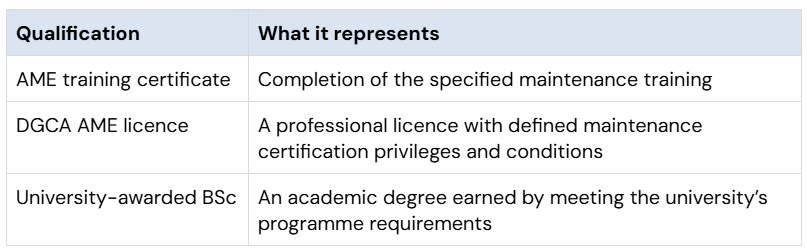
A combined AME and BSc programme may provide both maintenance training and a degree. However, the BSc must be awarded separately by a university authorised to award that qualification.
Acceptance for further study or employment is another question. The University Grants Commission’s guidance on equivalence explains that the receiving university determines equivalence for higher education, while the employer determines it for employment.
If an institute describes its course as “equivalent to graduation”, ask for the official document supporting that statement and check its purpose. Acceptance for a particular job or admission process should not be interpreted as the award of a BSc degree.
What Are the Fees for Aircraft Maintenance Courses in India?
The cost of an Aircraft Maintenance Engineering (AME) course in India depends on the training institute, licence category, practical training arrangements, and whether the programme includes a university degree.
Based on published fee schedules from Indian training providers, standalone AME training may cost approximately ₹4.5 lakh to ₹7 lakh for the programme. For example, Sha-Shib Scholarship and Aptitude Test (SSAT) list fees of ₹4.5 lakh for B1.2 and ₹6.25 lakh for B1.1/B2 training, while Thakur Institute of Aviation Technology (TIAT) lists fees totalling approximately ₹7 lakh over two years for its specified licence courses. Silver Oak University publishes a fee of approximately ₹6.13 lakh for its AME licence course, with hostel and transport charged separately.
These figures are indicative examples from published fee schedules and not a fixed national fee. Combined AME and BSc programmes may have different costs because they can include separate university tuition, registration and academic expenses.
Before enrolling, request an itemised fee quotation covering the following components:
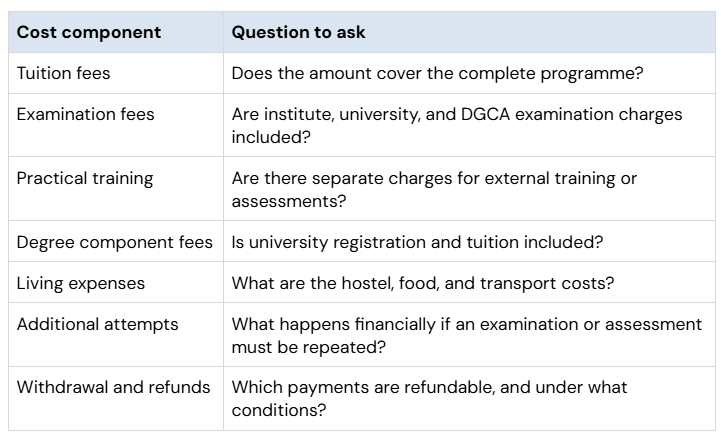
Compare the total expected cost, payment schedule, exclusions and refund policy, rather than looking only at the initial admission fee. A low first instalment does not necessarily mean the programme will cost less to complete.
Students considering VIA should request a current, written fee breakdown directly from the institute. Confirm which training, examinations, and practical arrangements are included before comparing its fees with those of other providers.
Does Completing an AME Course Automatically Grant You an AME Licence?
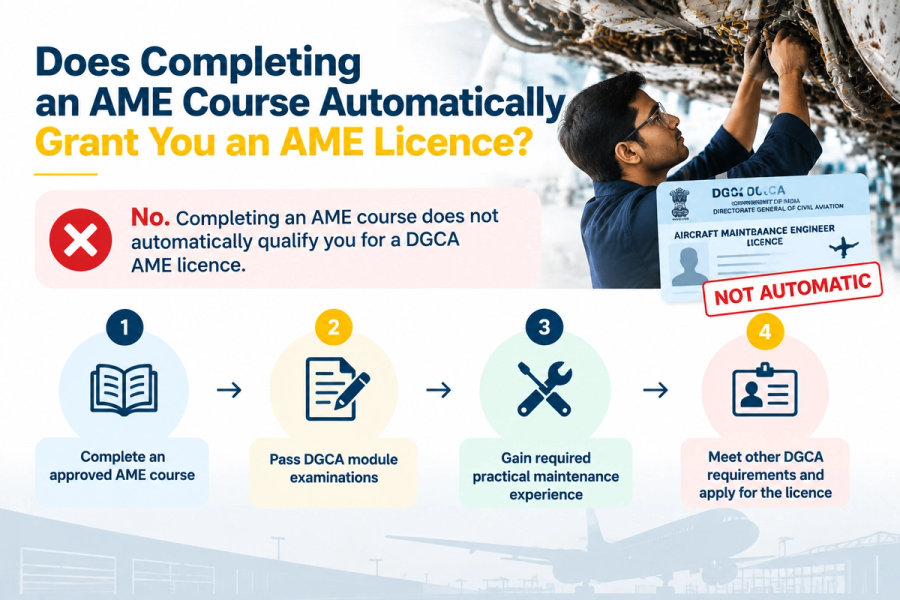
No. Completing an Aircraft Maintenance Engineering (AME) course does not automatically qualify you for a DGCA AME licence. Course completion, passing the required examinations, and obtaining a licence are separate milestones.
Under DGCA CAR-66, applicants must satisfy the applicable basic knowledge examination and practical maintenance experience requirements, along with other conditions relevant to their licence category and application pathway.
Completing an approved basic training programme can support your licensing pathway, but it does not replace the required practical experience or other outstanding requirements.
Keep copies of your DGCA examination results, training certificates, and practical maintenance records throughout your studies. Ask your training organisation to explain which requirements its programme fulfils and what you must complete independently.
VIA’s guide to starting a career in aviation maintenance provides broader career context.
What Should You Check Before Taking Admission to an AME Course?
A good admissions discussion should provide clear, verifiable documents rather than relying on general assurances or verbal promises.
Verify the DGCA Training Approval
Request the current approval certificate and scope for the organisation delivering any claimed approved basic maintenance training. The category and location should match the programme being offered.
Check the BSc Degree Separately
DGCA approval for AME training does not establish that an institute is authorised to award a university degree. If the programme includes a BSc, ask for the awarding university’s official programme details and written confirmation that the arrangement applies to your intended intake.
Review the Practical Training Plan
Ask where practical training takes place, which activities are included, how students are assessed, and what records they receive. Clarify whether the programme includes structured practical training, supervised maintenance experience, or only activities such as workshops and industrial visits.
Understand the Placement and Career Support
Ask the institute to explain exactly what its placement assistance includes. Interview preparation, employer referrals, internships and confirmed employment are different outcomes.
Admission to an AME course does not guarantee a job or an AME licence. Review the programme’s written terms and understand which training, examinations, experience and licensing requirements you will still need to complete.
Know What Your AME Admission Will Lead To
A clear course choice begins with three questions: What will I study, what qualification will I receive, and what requirements will remain afterwards?
Discuss these questions with Vision Institute of Aviation’s admissions team. Bring your academic documents and request a written explanation of the course category, training arrangements, qualification awarded, and complete fees before making your decision.
Frequently Asked Questions
Is a BSc compulsory to become an aircraft maintenance engineer?
A BSc is not a universal requirement for an AME licence. Candidates must satisfy the applicable DGCA requirements for their licensing route. A degree is a separate academic qualification.
Is AME the same as aeronautical engineering?
No. Aircraft Maintenance Engineering (AME) and aeronautical engineering are different career pathways. AME focuses on aircraft maintenance, inspections, troubleshooting, and the licensing requirements associated with certifying maintenance work. Aeronautical engineering generally focuses on the engineering principles involved in aircraft design, development, analysis, and testing.
The qualifications also differ. AME follows a DGCA-regulated licensing pathway, while aeronautical engineering is typically pursued through a university engineering degree. Compare the curriculum, qualification awarded, and career opportunities before choosing between them.
Can I join an aircraft maintenance course after Class 10?
Class 10 alone does not meet the standard academic requirement for DGCA AME examination registration, which is 10+2 with Physics, Chemistry, and Mathematics (PCM), or an accepted equivalent qualification.
If you have completed Class 10, you will generally need to complete the required higher secondary education or an accepted equivalent qualification before meeting the academic eligibility criteria.