How Do I Start a Career in Aviation Maintenance?
Learn how to become an Aircraft Maintenance Engineer in India with this complete guide covering AME courses, eligibility, training, exams, and careers.
The aviation industry is not only about pilots flying aircraft. Behind every safe flight, there is a team of skilled aviation professionals who inspect, maintain, repair, and certify aircraft before they take off. One of the most important careers in this field is Aircraft Maintenance Engineering (AME).
A career in aviation maintenance begins with completing 10+2 with Physics, Chemistry, and Mathematics (PCM), followed by enrolment in a DGCA-approved Aircraft Maintenance Engineering (AME) course in India. Students must complete the required technical training, clear DGCA examinations, and gain practical maintenance experience to build a professional career with airlines, Maintenance Repair Organisations (MROs), airports, and aviation companies.
This guide explains everything you need to know about becoming an Aircraft Maintenance Engineer in India.
What is Aviation Maintenance?
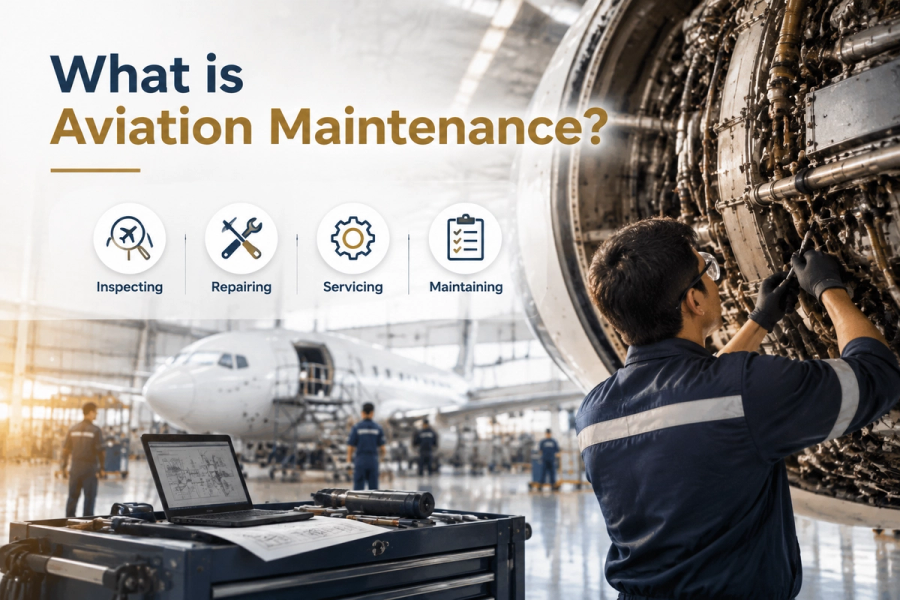
Aviation maintenance is the process of inspecting, repairing, servicing, and maintaining aircraft to ensure they are safe and airworthy before flight operations.
Every aircraft requires regular maintenance to operate safely. Aircraft maintenance professionals check engines, electrical systems, avionics, aircraft structures, and other critical components to identify problems and prevent failures.
An Aircraft Maintenance Engineer (AME) is the aviation professional responsible for ensuring that aircraft meet safety and regulatory requirements before they return to service.
Unlike pilots who operate aircraft, AMEs work behind the scenes to make sure every aircraft is technically safe to fly.
How to Start a Career in Aviation Maintenance in India?
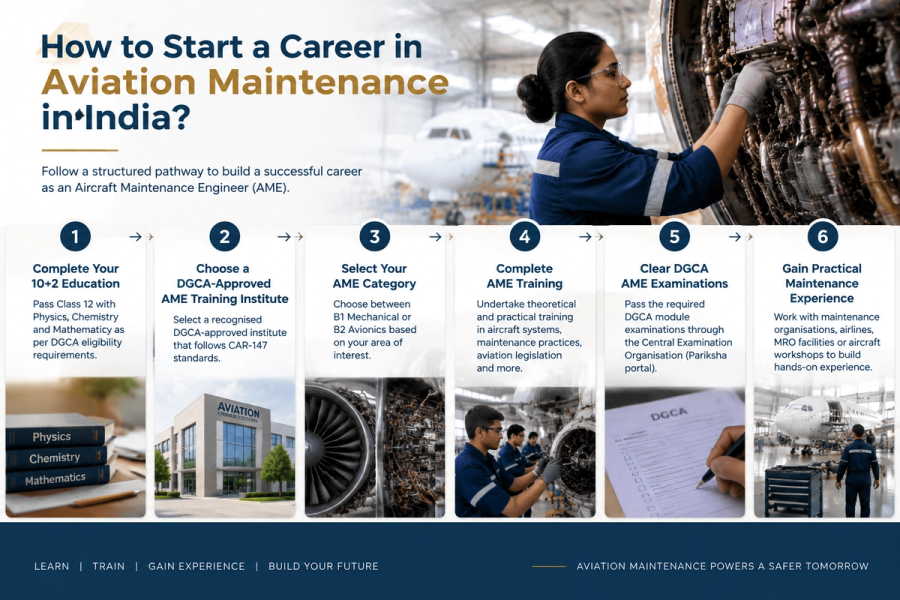
Starting a career in aviation maintenance requires following a structured pathway.
Step 1: Complete Your 10+2 Education With Physics and Mathematics
The first requirement for becoming an AME is completing Class 12 with the required science subjects.
DGCA AME eligibility requirements specify that candidates should have passed 10+2 with Physics, Chemistry, and Mathematics or equivalent qualifications.
Students who have completed certain engineering diplomas may also be eligible depending on applicable regulations.
Step 2: Choose a DGCA-Approved AME Training Institute
After completing 12th grade, students should select a recognised DGCA-approved Aircraft Maintenance Engineering (AME) training organisation. The Vision Institute of Aviation is among the best AME and cabin crew training institutes in India.
Choosing the right institute is one of the most important decisions because quality training directly impacts technical knowledge, practical skills, and career readiness.
DGCA-approved AME training organisations operate under CAR-147 requirements and follow approved maintenance training standards.
Step 3: Select Your AME Category
AME training is divided into different categories based on the type of aircraft systems a student wants to specialise in.
The two major categories are:
AME Category Specialisation
B1 Mechanical Aircraft structure, engine, airframe, mechanical systems
B2 Avionics Electrical systems, instruments, communication, navigation systems
Step 4: Complete AME Training
The AME course includes both theoretical learning and practical training.
Students study subjects such as:
- Aviation legislation
- Aircraft systems
- Aerodynamics
- Maintenance practices
- Materials and hardware
- Electrical fundamentals
- Human factors
- Safety procedures
Many DGCA-approved AME programmes are structured over multiple semesters, combining classroom learning and practical training.
Vision Institute of Aviation offers practical training that helps students understand real aircraft maintenance environments and develop industry-ready skills.
Step 5: Clear DGCA AME Examinations
After completing training, candidates need to clear the required DGCA examinations.
The DGCA AME examination process includes technical modules based on the selected category.
DGCA manages AME examinations through its Central Examination Organisation and Pariksha portal.
Step 6: Gain Practical Maintenance Experience
Aircraft maintenance is a skill-based profession. Practical exposure is essential before taking on professional responsibilities.
Students gain experience through:
- Maintenance organisations
- Airlines
- MRO facilities
- Aircraft workshops
This practical experience helps students understand:
- Aircraft inspection procedures
- Maintenance documentation
- Safety standards
- Real-world troubleshooting
What is Aircraft Maintenance Engineering (AME)?
Aircraft Maintenance Engineering (AME) is a specialised aviation programme that trains students to maintain and certify aircraft systems.
An AME does not fly aircraft. Instead, an AME ensures that aircraft are:
- Mechanically safe
- Properly maintained
- Technically inspected
- Compliant with aviation regulations
What are the Eligibility Requirements for AME Course in India?
Requirement Details
Educational Qualification 10+2 with Physics, Chemistry, Mathematics
Medical fitness No physical disability and no colour blindness
Eligibility requirements should always be confirmed with the selected DGCA-approved training institute because regulations may change.
Which AME Course Should I Choose?
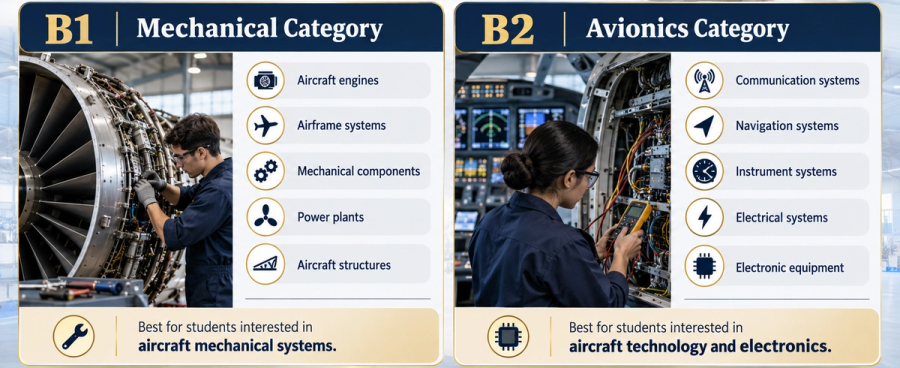
AME training is mainly divided into two major categories:
B1 Mechanical Category
The B1 category focuses on the mechanical aspects of aircraft.
Students learn about:
- Aircraft engines
- Airframe systems
- Mechanical components
- Power plants
- Aircraft structures
This category is suitable for students interested in aircraft mechanical systems.
B2 Avionics Category
The B2 category focuses on aircraft electrical and electronic systems.
Students learn about:
- Communication systems
- Navigation systems
- Instrument systems
- Electrical systems
- Electronic equipment
This category is suitable for students interested in aircraft technology and electronics.
How Long Does it Take to Become an Aircraft Maintenance Engineer?
The duration of an Aircraft Maintenance Engineering (AME) course depends on the selected category, training structure, DGCA examination requirements, and practical experience.
At Vision Institute of Aviation (VIA), the AME training programme is designed as a 2-year course divided into 4 semesters, following the DGCA CAR-66 module structure.
During the programme, students complete:
- AME theoretical training based on the DGCA CAR-66 syllabus
- Institute semester examinations and DGCA modular examinations
- Practical aircraft maintenance training through in-house and industry-based exposure
- Required documentation and certification process
The practical training includes 360 hours of hands-on maintenance experience at DGCA CAR-145 approved Aircraft Maintenance Organisations (AMOs), providing students with exposure to real aircraft maintenance environments.
Training opportunities include exposure to reputed aviation organisations such as Air India, GoAir, SpiceJet, Air Works India, and Max MRO for B1.1, B1.2, and B2 categories.
After successful completion of training requirements, examinations, and practical experience, students receive a Certificate of Recognition and can progress towards their AME career pathway.
Why Choose a Career in Aviation Maintenance?
The aviation industry is expanding rapidly, with increasing aircraft fleets, airline operations, and maintenance requirements. Every aircraft requires qualified professionals throughout its operational life.
A career in aviation maintenance can be suitable for students who enjoy:
- Aircraft technology
- Engineering concepts
- Problem-solving
- Practical technical work
- Aviation safety
- Working in a highly regulated industry
Some major advantages of choosing aviation maintenance include:
Benefit Explanation
Aviation Industry Career Opportunity to work with airlines, airports, MRO organisations, and aviation companies.
Technical Expertise Learn advanced aircraft systems and maintenance technology.
Global Opportunities Aviation maintenance skills are recognised internationally.
Diverse Career Paths Opportunities in mechanical, avionics, inspection, and maintenance roles.
Long-Term Growth Aircraft require continuous maintenance throughout their lifecycle.
Career Opportunities After Aircraft Maintenance Engineering
After completing AME training and fulfilling licensing requirements, candidates can explore various aviation career opportunities.
Airline Maintenance Engineer
Airlines employ maintenance professionals to ensure aircraft remain operational and safe.
Responsibilities include:
- Aircraft inspections
- Maintenance checks
- Fault identification
- Technical documentation
Aircraft Maintenance Organisation (MRO) Professional
Aircraft MRO organisations specialise in aircraft maintenance, repair, and overhaul activities.
AME professionals can work on:
- Scheduled maintenance
- Component repairs
- Aircraft modifications
Aircraft Manufacturing Companies
Aircraft manufacturers and aerospace companies require skilled maintenance and technical professionals for testing, support, and maintenance activities.
Aviation Safety and Technical Roles
Experienced aviation maintenance professionals can move into:
- Quality assurance
- Technical management
- Maintenance planning
- Safety management roles
Skills Required to Become a Successful Aircraft Maintenance Engineer
A successful Aircraft Maintenance Engineer requires a combination of technical knowledge and professional skills.
Important skills include:
- Understanding aircraft systems, engineering principles, and maintenance procedures is essential.
- Aircraft maintenance requires accuracy because even a small mistake can affect aircraft safety.
- AME professionals must identify technical issues and find effective solutions.
- Aviation follows strict procedures. Maintenance engineers must follow regulations, checklists, and safety standards.
- Aircraft technology continues to evolve, making lifelong learning important for aviation professionals.
Is Aviation Maintenance a Good Career Choice in India?
India’s aviation sector continues to expand, creating demand for skilled aviation professionals across airlines, airports, and maintenance organisations.
Students who are interested in aircraft technology but prefer engineering and technical work over flying, Aircraft Maintenance Engineering can be a rewarding career path.
A successful career depends on:
- Choosing the right DGCA-approved training institute
- Building strong technical knowledge
- Developing practical skills
- Maintaining aviation safety standards
- Continuing professional development
Why Choose Vision Institute of Aviation for Your AME Career?
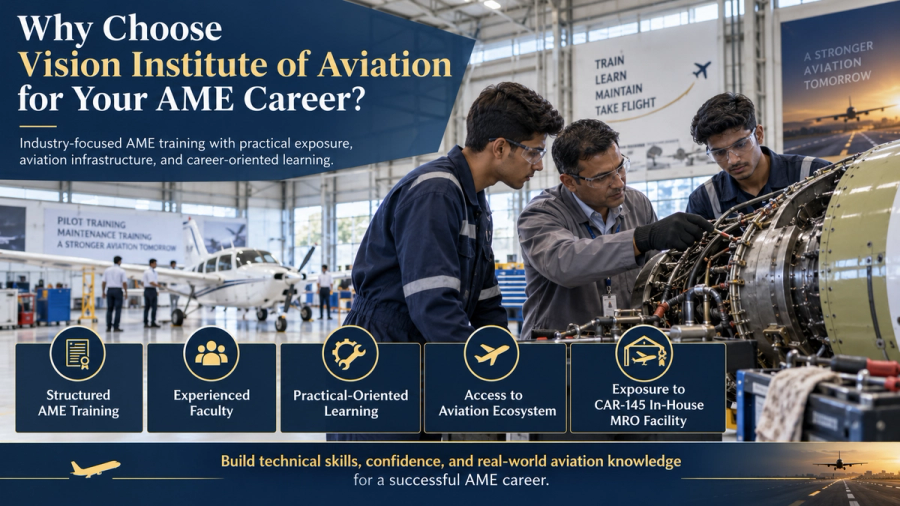
Starting a career in Aircraft Maintenance Engineering (AME) requires more than theoretical knowledge. Students need practical exposure, technical understanding, aviation safety awareness, and guidance from experienced professionals to develop the skills required for success in the aviation industry.
Vision Institute of Aviation (VIA), a part of Vision Group of Institutions, provides structured Aircraft Maintenance Engineering training designed to prepare students for professional opportunities in aircraft maintenance. Through experienced faculty, industry-focused curriculum, and practical-oriented learning, VIA helps students understand aircraft systems, maintenance procedures, aviation regulations, and industry standards.
Being part of Vision Group of Institutions provides VIA students with the advantage of being connected to a complete aviation ecosystem. The group also includes Vision Flying Training Institute (VFTI), which provides pilot training supported by a CAR-145-approved in-house Maintenance, Repair, and Overhaul (MRO) facility.
This aviation infrastructure creates valuable opportunities for students to understand real-world aircraft operations and maintenance practices. While VFTI enables aspiring pilots to receive flight training in a safe and professionally managed environment, the group’s MRO facility provides AME students with practical exposure to aircraft maintenance processes, safety procedures, and industry standards.
With technical training, practical learning opportunities, and the support of Vision Group of Institutions’ aviation ecosystem, Vision Institute of Aviation (VIA) helps aspiring Aircraft Maintenance Engineers develop the knowledge, confidence, and skills required to build a successful career in aviation maintenance.
Conclusion
A career in aviation maintenance is an excellent choice for students who are passionate about aircraft, technology, and aviation safety.
The journey begins with choosing the right AME course, completing approved training, gaining practical experience, and developing the technical skills required by the aviation industry.
If you dream of building a career around aircraft but want to work behind the scenes, ensuring every flight is safe, Aircraft Maintenance Engineering can be the right aviation career path for you.
Start your aviation journey with the right training, the right guidance, and the right institute.
Have questions about the AME course, eligibility, admission process, or career opportunities in aviation maintenance? Our team at Vision Institute of Aviation is here to guide you through every step of your aviation journey.
Get in touch with us today and take the first step towards building a successful career in Aircraft Maintenance Engineering.
Visit us:Admission Office/Ground ClassesF-647, Palam Extension, Sector 7, Dwarka,New Delhi – 110075
Call: +91 931 919 3605
Email us at office@visioninstituteofaviation.com
Frequently Asked Questions About Aviation Maintenance Career
What qualification is required to become an Aircraft Maintenance Engineer?
Students generally need to complete 10+2 with Physics, Chemistry, and Mathematics from a recognised board to pursue AME training in India.
Is AME a good career option in India?
Yes, AME is a specialised aviation career that offers opportunities with airlines, MRO organisations, airports, and aviation companies.
Can an AME work with airlines?
Yes. Licensed and qualified AME professionals can work with airlines, maintenance organisations, and other aviation companies.
What is the difference between AME and aeronautical engineering?
AME focuses on aircraft maintenance, inspection, and airworthiness, while aeronautical engineering focuses more on aircraft design, development, and engineering research.
What is the salary of an aircraft maintenance engineer?
The salary of an AME depends on factors such as licence status, experience, aircraft type, employer, and location.
Is AME better than pilot training?
AME and pilot training are different aviation career paths. Pilots operate aircraft, while AMEs maintain aircraft safety and airworthiness. The right choice depends on a student's interests, skills, and career goals.