How to Become an Air Hostess After 12th in India
Learn how to become an air hostess after 12th in India. Check airline eligibility, course options, application steps, interview preparation, and training requirements.
Becoming an air hostess after Class 12 involves meeting an airline’s eligibility criteria, applying for a suitable vacancy, clearing its selection process, and completing the required airline training.
A graduation degree or private air hostess course is not a universal entry requirement. Your next step depends on your age, qualifications, and readiness for recruitment.
The process becomes easier to understand when you separate preparing for an airline interview from training to perform cabin duties after selection. These serve different purposes. Interview preparation can help you improve your communication, grooming, and confidence, but it does not guarantee employment or replace the airline’s mandatory training programme.
Can You Become an Air Hostess After 12th?
Yes. Airlines offer entry-level cabin crew opportunities to eligible Class 12 candidates.
“Air hostess” generally refers to a female flight attendant. Airlines commonly advertise these positions as cabin crew or cabin attendant roles, so use those terms when searching for vacancies. VIA’s guide to cabin crew and air hostess terminology explains the distinction.
A Class 12 certificate meets only the educational part of an application. Age, communication, passport status, physical criteria, and medical assessment also matter.
What Are the Eligibility Requirements to Become an Air Hostess in India in 2026?
There is no single set of air hostess eligibility requirements that applies to every airline in India. Criteria can vary by airline, position, and recruitment notice. The requirements below are based on published criteria for fresher cabin crew roles and should be treated as practical examples rather than industry-wide rules. Always check the latest official vacancy before applying.
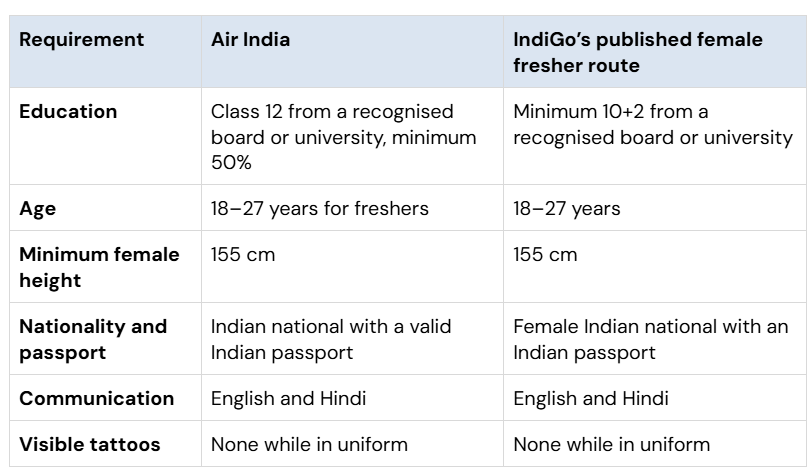
Check the complete Air India cabin crew criteria and IndiGo inflight services requirements against the specific vacancy before applying.
Weight, body mass index, and medical conditions require separate attention. Individual fitness questions should go through the airline’s recruitment team and designated medical assessment process. An institute’s admission decision cannot establish airline medical eligibility.
Can Arts and Commerce Students Become an Air Hostess After Class 12?
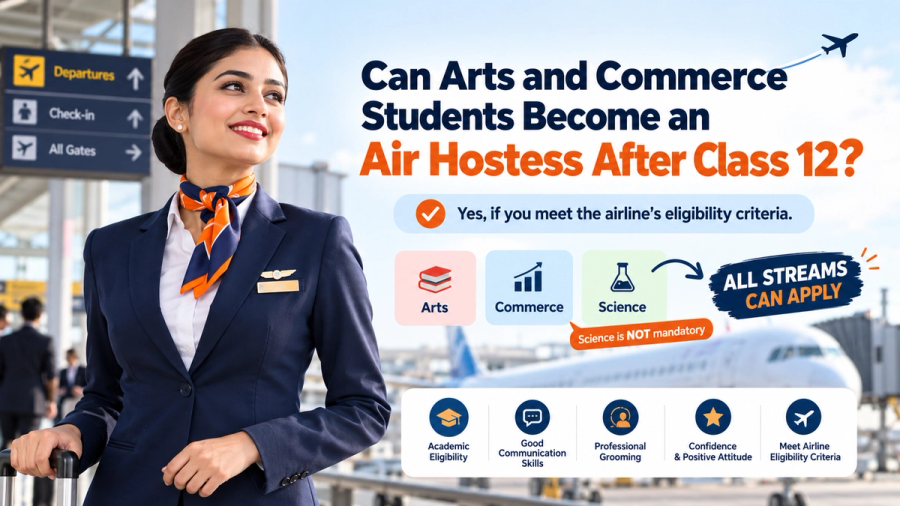
Yes. Arts and Commerce students can apply for air hostess or cabin crew jobs after Class 12, provided they meet the eligibility requirements stated in the airline’s vacancy. The published fresher criteria discussed above do not require candidates to have studied Science, Physics, or Mathematics.
Your preparation should focus on your individual strengths and gaps rather than your academic stream. One candidate may need more interview practice, while another may need to improve spoken English, grooming, or confidence. Studying Arts, Commerce,or Science alone does not determine whether you are ready for a cabin crew role.
Seven Steps to Become an Air Hostess After Class 12 in India

1. Check Your Eligibility Before Paying for an Air Hostess Training
Create an eligibility checklist for the airlines you are considering. Record their current educational requirements, age limits, passport rules, and other published conditions.
Separate each point into three groups:
- Already met: You have the required qualification or document.
- Needs preparation: You need stronger communication, grooming, or interview skills.
- Needs clarification: Your documents or individual circumstances require confirmation from the airline.
This step can prevent you from spending money on a private air hostess course before understanding whether you meet the requirements of your intended employer.
2. Understand the Work Behind the Air Hostess Job Title
Cabin crew work includes passenger safety, emergency responsibilities, and customer service. Your preparation should reflect all these parts of the role.
Think about how you respond when a passenger is upset, instructions change unexpectedly, or your team needs support. Clear communication, patience, teamwork, and dependable behaviour are as important as professional presentation.
Research the airline’s cabin crew role before preparing interview answers. An answer based only on enjoying travel gives recruiters little evidence of your suitability.
3. Decide Whether You Need an Air Hostess Preparation Course
A private air hostess or cabin crew course is not a universal requirement for applying to airlines. Eligible candidates can apply through official airline recruitment channels without assuming that a particular institute certificate is required.
However, a structured course may be useful when you need regular coaching, practical service exercises, grooming guidance, or interview feedback. Evaluate the actual training and support offered rather than the promise of a job.
Before enrolling, ask the institute these questions:
- How much one-to-one communication and spoken English practice is included?
- Will I receive personalised feedback after mock interviews?
- Which practical activities and cabin crew exercises will I complete?
- What does the institute’s placement assistance actually include?
- What is the total course fee, including registration, materials, and any additional charges?
Airline training after selection remains a separate stage. A private air hostess or cabin crew course should not be presented as a substitute for it.
4. Prepare Your Cabin Crew CV and Documents
Start organising your documents before a suitable airline vacancy or interview is announced. A useful preparation folder includes:
- An updated CV.
- Class 10 and Class 12 certificates or marksheets.
- A valid passport and other identity documents.
- Recent photographs matching the application instructions.
- Previous employment records, where applicable.
The airline’s current vacancy notice determines which documents are required during the application, interview, and joining stages.
Check that your name, date of birth, and other details are consistent across all documents. A passport application acknowledgement should not be assumed to replace a valid passport unless the airline explicitly accepts it.
Your CV should include genuine examples of teamwork, responsibility, communication, and customer interaction. School events, volunteering, internships and part-time work may provide useful evidence.
VIA’s guide to standing out in flight attendant job applications explains how to present these strengths effectively.
5. Apply Through the Airline’s Official Recruitment Channel
Search the airline’s careers website for cabin crew vacancies and hiring events. Follow the instructions attached to the particular opening.
Air India, for example, requires candidates to complete an online application before attending certain walk-in interviews. A vacancy described as a “walk-in” does not always mean that advance registration is unnecessary.
Keep a simple application tracker with the vacancy link, application date, interview location, and documents requested.
6. Prepare for Cabin Crew Assessments and Interviews
The selection process varies by airline and vacancy. Follow your invitation carefully instead of assuming that every airline uses the same interview rounds.
Prepare a clear self-introduction and examples that show how you communicate, cooperate, and solve problems. Common practice questions include:
- Why do you want to become cabin crew?
- How would you handle an upset passenger?
- When have you helped a team complete a difficult task?
- What do you know about this airline?
- How would you respond if a passenger refused to follow a safety instruction?
Use genuine experiences instead of invented stories or memorised scripts. A simple and specific answer is usually more convincing than a long rehearsed speech.
Practise listening as carefully as speaking. During a group activity, contributing constructively is more useful than trying to dominate the conversation.
7. Complete Medical, Joining and Airline Training Requirements
Candidates who clear the selection process must still complete the airline’s medical, documentation, background verification, and joining requirements.
Air India confirms that successful candidates must complete a pre-employment medical assessment and the required airline training.
Read your offer carefully and clarify the following before accepting:
- Assigned base and training location.
- Air hostess’s training-period salary or stipend.
- Accommodation and transport arrangements.
- Joining date and document deadlines.
- Contractual conditions, deductions or repayment obligations.
IndiGo states that selected cabin crew complete approximately three months of intensive training before beginning flying duties. This is an airline-specific example and should not be treated as a guaranteed timeline for every recruitment process.
You become operational cabin crew only after meeting the airline’s eligibility requirements, clearing its selection process, and successfully completing the required training.
How Long Does It Take to Become an Air Hostess After Class 12?
There is no fixed timeline for becoming an air hostess after Class 12 because preparation, airline recruitment, and post-selection training are separate stages.
Your individual timeline depends on whether you already meet the airline’s eligibility criteria, when suitable cabin crew vacancies become available, how you perform during the selection process, and when the airline’s next training batch begins.
Consider the journey in three stages:
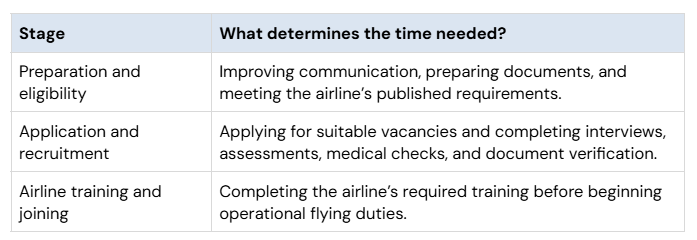
A private cabin crew course may help you prepare, but it does not determine how quickly an airline will recruit, select, or train you.
How Much Does It Cost to Become an Air Hostess After Class 12 in India?

The cost of becoming an air hostess after Class 12 depends on the route you choose. A private cabin crew preparation course is optional and should be considered separately from expenses related to airline applications, interviews and joining.
Your budget may need to cover:
- Optional air hostess or cabin crew course fees.
- Passport, photographs and other documents.
- Travel and accommodation for interviews.
- Medical examinations where required.
- Grooming, formal clothing and application-related expenses.
- Relocation, rent and living costs before regular salary begins.
Ask for written details of any registration fee, security deposit, training bond or repayment condition. Confirm who is collecting the payment, why it is required, and whether it is refundable.
There is no universal air hostess licence fee in India. Paying a private institute does not guarantee airline selection, employment or a particular salary. Compare the course content, total cost, and support provided before enrolling.
Can You Join an International Airline as Cabin Crew After Class 12?
Completing Class 12 may satisfy the educational requirement for some international cabin crew jobs, but it does not necessarily make you eligible to apply immediately. Airlines may also set requirements related to minimum age, customer service experience, communication skills, height and reach, visa eligibility, and medical fitness.
Emirates, for example, currently requires cabin crew applicants to be at least 21 years old, have completed at least Grade 12, and possess a minimum of one year of hospitality or customer service experience. Applicants must also meet its English-language, height, arm-reach, tattoo, and UAE employment-visa requirements.
A student who has just completed Class 12 should therefore review the full eligibility criteria of each international airline rather than focusing only on the educational requirement. Relevant customer-facing experience in hospitality, retail, travel or another service role can help you build experience while waiting to meet an airline’s age and recruitment conditions.
Always confirm the latest requirements on the airline’s official careers page before applying, as cabin crew eligibility criteria can change.
Choose Training Around the Skills You Need
Your Class 12 results are a starting point. Before enrolling anywhere, identify what would help you most: clearer spoken English, confidence in interviews, or practice handling passenger situations.
Vision Institute of Aviation’s cabin crew programme describes a one-year, two-semester course covering communication, grooming, passenger service, safety awareness and interview preparation. Compare those subjects with your own preparation needs rather than choosing a course on its name alone.
Bring that shortlist to a course discussion with VIA. Ask how the sessions address those skills, what feedback you will receive and what the complete fee covers. Clear answers will help you decide whether the programme is right for you.
Frequently Asked Questions
Can I Apply for Air Hostess Jobs at 17?
The Indian fresher cabin crew routes discussed above require applicants to be at least 18 years old. Check the official vacancy to understand whether age is calculated on the application date, interview date, or joining date.
While waiting to become eligible, you can prepare your documents, improve your English communication and interview skills, and research airline cabin crew requirements.
Is There a Compulsory Air Hostess Entrance Exam?
No. There is no single national entrance examination that every aspiring air hostess must pass. Airlines conduct their own recruitment processes, which may include interviews, group activities, communication assessments, document checks, and medical examinations.
An entrance test conducted by a private institute is separate from airline recruitment and does not replace the airline’s selection process.
Can I Become an Air Hostess Without Fluent English?
Airlines generally require cabin crew candidates to communicate clearly in English. Candidates who find it difficult to understand questions, follow instructions, or explain their ideas should strengthen these skills before applying.
Focus on clear pronunciation, understandable speech, attentive listening, and natural responses. You do not need to imitate a foreign accent.
Does Completing an Air Hostess Course Guarantee a Job?
No. A private air hostess or cabin crew course may help you improve your communication, grooming, service skills, and interview performance, but the airline controls recruitment and selection.
Ask the institute to explain exactly what its placement assistance includes. It should not present interview support or vacancy updates as guaranteed airline employment.